
SEO in New Zealand can be priced as a one-off audit, a fixed project or a monthly retainer. A report that identifies problems costs differently from a project that fixes them. A monthly proposal might also include writing, publishing, local profile work and ongoing measurement. Compare what each provider will deliver before comparing their fees.
Start with the problem you need to solve. A Nelson electrician who wants more suitable local enquiries needs a different scope from an online retailer with hundreds of product variants, or a business about to change its website platform.
How much does SEO cost in NZ?
Seed Studio advertised a one-off technical report from NZ$497 + GST. AI Systems ANZ listed a technical audit with fixes from NZ$1,500 + GST. Airea Digital listed a local retainer at NZ$999 + GST per month. These are individual advertised offers checked on . They do not represent a NZ market average or an A1 Websites quotation.
Separate an audit, a project and ongoing SEO
A useful audit ends with priorities and a handover. A project ends with a defined set of changes and checks. A retainer makes sense when there is a continuing list of work to implement and evidence to review. Ask whether the audit, initial setup and reporting are included in the monthly fee or billed separately.
| Engagement | What the scope should say |
|---|---|
| One-off SEO audit | Which pages, templates and data are reviewed. Ask for evidence, priorities and a handover that your team can act on. Confirm whether fixes are separately quoted. |
| Technical SEO project | Which issues the provider will fix, who can edit the site and how fixes will be tested. Examples include pages blocked from indexing, broken redirects or inconsistent canonical tags. |
| Local SEO | Which locations and services are covered, what happens to the Google Business Profile, and which service pages, listings or review processes will be improved. Can be a one-off setup or ongoing work. |
| Ecommerce SEO | Which collections, products and templates are in scope. Ask whether filter and variant URLs, out-of-stock handling, product information and revenue tracking are included. |
| Migration or redesign SEO | URL inventory, redirect mapping, staging checks, launch verification and a defined monitoring window. Confirm who implements the redirects and whether design or development is a separate fee. |
| Content and on-page work | Which pages are reviewed, written, revised, published and linked. A content plan, a page rewrite and a published page are three different deliverables. |
| Monthly management | Work planned for the first month and after setup, how priorities can change, any limits on time or deliverables, and a reporting and review schedule. |
What public NZ prices show
These are individual advertised offers checked on . The sample shows how providers price different scopes. It is too small and varied to establish a New Zealand market average, a recommended budget or the price of work on your website. Ask for a written quote and confirm its GST treatment and inclusions.
| Advertised offer | Price and scope |
|---|---|
| Seed Studio technical and local reports | From NZ$497 + GST for the technical report and NZ$297 + GST for the local report, one-off. The technical report examines website and search data and already includes the full Local SEO Report analysis. The standalone local report focuses on Maps and local presence. If you buy the technical report, you only pay for that report to get both analyses. Seed Studio report pricing · Technical report inclusions. |
| AV Consulting one-off SEO audit | NZ$3,000 + GST for a 25-hour audit. The provider lists review and monitoring separately, illustrating why it helps to ask what happens after delivery. AV Consulting SEO pricing. |
| AI Systems ANZ technical audit and fixes | From NZ$1,500 + GST for a fixed-scope package that includes fixes. Confirm the specific changes and the retest in the written scope. AI Systems ANZ package pricing. |
| Airea Digital Starter and Growth | NZ$999 + GST and NZ$2,200 + GST per month respectively, with a three-month minimum. Starter is for one location. Growth covers a wider scope and includes a larger content allocation. Airea Digital package pricing. |
| seo.expert Ecommerce | NZ$449 per month, with no GST added according to the provider. The offer specifies two collection or category pages and ten product titles and descriptions per month. Paid apps and licences are excluded. seo.expert plan pricing. |
| Seed Studio content review and plan | From NZ$1,450 + GST, one-off, for prioritising what to revise, write or remove. Confirm any writing and publishing fees separately. Seed Studio content planning offer. |
| Authentic Digital migration support | Fixed-scope migration projects are quoted for the site. Ask for a separately priced breakdown covering the URL map, staging review and post-launch monitoring. Authentic Digital migration scope. |
Google Business Profile is free for eligible businesses. A provider can charge for managing it, such as fixing business details, organising photos or reviewing local visibility. Ask who owns the profile and what work the fee covers. Google’s Business Profile eligibility and setup guidance.
What changes the amount of work?
- Market and service area. One location and two priority services are easier to scope than multiple locations and a national catalogue. Establish which customers you can serve and which searches lead to work worth taking on.
- Site size and how problems repeat. A single template fix can affect many pages. A catalogue with inconsistent product data may need decisions at template, collection and product level. Ask which changes apply sitewide and which are manual.
- Starting condition and access. Work can stall when nobody can edit templates, verify Search Console or check enquiries. Confirm who controls the website, analytics, Business Profile and any developer accounts.
- Who writes and implements. A page brief leaves writing, approval and publishing to someone else. Technical advice leaves development and testing to someone else. Price those responsibilities when comparing proposals.
- Risk and timing. A launch date, changing URLs or an upcoming peak trading period can require more preparation, closer monitoring and a clear recovery plan.
When A1 scopes SEO, we start with the pages and searches that matter to the business, check what the site is actually doing and agree who can implement the changes. Before a redesign, we record the important URLs, map any that need to move and check what the new site returns after launch. That sequence gives the business a way to check what was delivered. How A1 scopes SEO work.
Three hypothetical NZ scopes
These examples illustrate how the work can differ. They contain no client data, quoted A1 fees or expected results.
Nelson electrician with one service area
Start with a Business Profile check, two priority service pages and a test of the website’s enquiry form. The owner can supply accurate hours, job photos, service areas and answers to common questions. In the proposal, specify who edits each page and profile field, how the form is tested, and how the team will record suitable enquiries. Review the completed setup before deciding whether to pay for monthly support. Local SEO checklist for Nelson businesses.
Christchurch online retailer with repeated product URLs
Sample important collections, products, variants and filters before rewriting hundreds of descriptions. Scope template fixes and test them on representative URLs first. Agree which collection pages are worth improving, who verifies specifications and how product changes will be published. Track organic sales and returns on the collections in scope. The retailer can supply stock and product knowledge. Give URL and template changes to someone who can test and reverse them. Google’s guidance on ecommerce URLs.
Established Wellington business redesigning its website
Quote the SEO migration as a workstream with a named owner, even if it sits inside the redesign contract. Record the current pages and search baseline, retain useful URLs where possible, and map changed URLs to suitable destinations. Agree who tests redirects, sitemap, indexing rules and enquiry tracking on launch day, and who checks them afterwards. This is separate from ongoing content work. A1’s website redesign process · Website handover and SEO checklist · Google’s site move guidance.
How to compare two SEO proposals
Give both providers the same brief. List the website, target services or products, locations, a business goal, existing access and any launch dates. Put the two offers side by side over the same review period. Include setup, monthly fees, separately quoted implementation, writing, licences and the time your team needs to supply. Compare on the same GST basis and check the minimum commitment, notice period and handover terms.
Example of a usable line item. “Review the two priority service pages, rewrite and publish the agreed copy, then test the enquiry path on mobile and log what changed.” In that example, the provider implements the agreed work, the owner confirms technical claims and approves copy, and the acceptance check is the published pages plus a tested enquiry path. New templates and call tracking are separate unless included in writing.
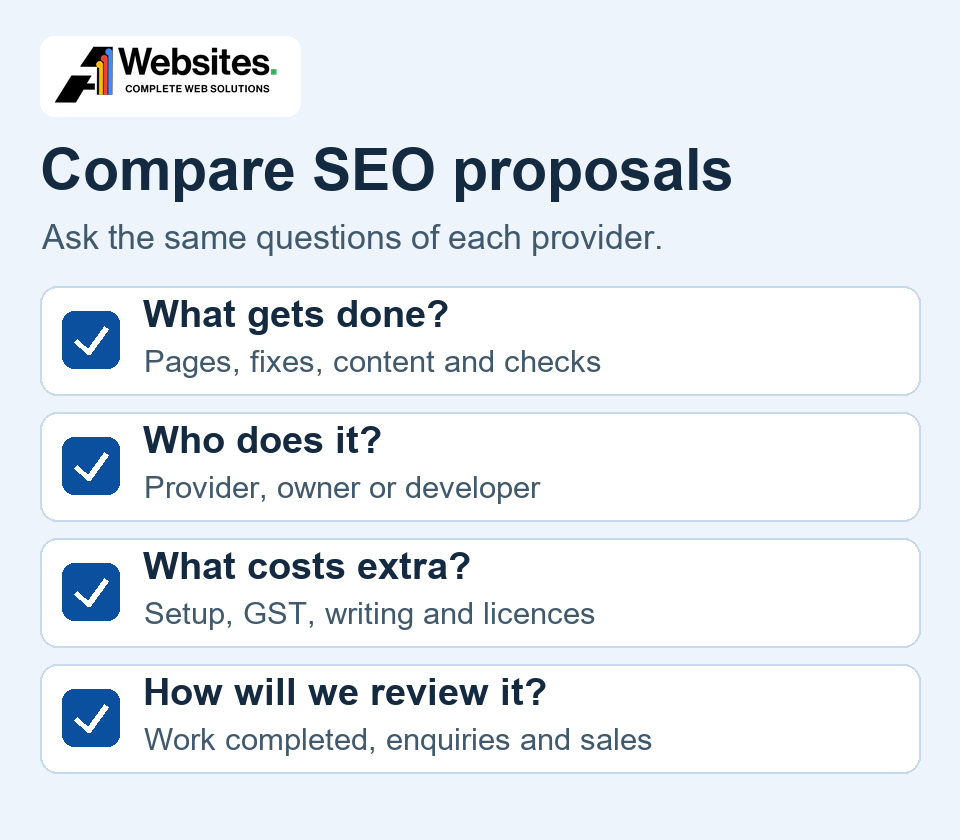
SEO proposal evaluation checklist
- Problem and baseline. What evidence supports the proposed work? Which pages, markets and outcomes will we use as a baseline?
- Deliverables and acceptance. Which URLs, templates or profiles are covered? What will I see when each item is complete?
- Implementation and approval. Who writes, publishes and tests? How many revisions are included? What input does my team owe and when?
- Fees and exclusions. What are the one-off and ongoing NZD fees? Is GST included, excluded or not charged? Which development, writing, licences and additional locations cost extra?
- Link-related work. Are they fixing internal links, correcting useful directory listings or doing outreach? Ask for examples of relevant sites and what the provider controls. Avoid paid links intended to manipulate rankings and automated link packages. Google’s link spam policy.
- Reporting and review. Which metrics, comparison periods and work completed will be reported? When will we decide whether to continue, narrow or expand the scope?
- Ownership and exit. Will the business retain access to its accounts, content and reports? What is handed over if we leave, and what happens to work in progress?
Be cautious of guaranteed rankings, a fixed number of links with no explanation of their sources, secret methods or a monthly report with no record of work. A provider can commit to doing agreed work by a date and reporting its outcome. Search placement depends on factors outside their control. For an initial audit, start with read access to Search Console. Google’s guidance on hiring an SEO provider.
Agree delivery and review dates separately
A focused audit can be time-boxed once access and scope are agreed. A template change may wait on a developer and needs a test before launch. A service page needs research, business input, approval and publishing. A migration needs checks before, during and after launch. Put dates against the work and agree when evidence will be reviewed.
For example, a small local project might book an audit handover after the first week of access, schedule page edits once the owner approves them, and review search and enquiry data after the first full month following publication. For a redesign, agree a pre-launch sign-off, a launch-day check and a post-launch review. These are example checkpoints. The time between them depends on access, approvals, development effort and the amount of data available.
Google says recrawling can take days or weeks, and a request alone does not guarantee indexing. For a site move, temporary fluctuations are possible while URLs are processed. Allow longer to judge commercial impact where enquiry volume is low or seasonal. Agree an initial review once there is enough relevant data to make a decision. Google’s recrawl guidance.
Judge the work by enquiries and sales
Ask for a report with the starting point, changes made and next decisions. Search Console shows Google Search impressions, clicks and the pages or queries behind them. Separate branded from relevant non-branded queries where data allows. Compare like periods and record significant changes such as a redesign, a seasonal peak or a tracking change. Google’s Search Console performance report.
Check organic visits and meaningful actions in analytics, then use enquiry or sales records to see whether those actions turned into work. Report suitable enquiries, booked jobs or retained orders alongside visibility. A ranking for a term you cannot serve has little commercial value. Record gaps such as untracked calls, and avoid crediting SEO for every sale that happened after the work started.
Illustrative value check. Suppose a project costs NZ$2,400 and a completed job contributes NZ$600 after variable job costs. It takes four additional completed jobs to cover that fee before overheads. If one in four qualified enquiries usually becomes a job, that is 16 additional qualified enquiries at the assumed close rate. This is a planning calculation with hypothetical inputs. Add your internal time and follow-up costs, and use a consistent GST basis and review period. An online store can use contribution per retained order after returns, fulfilment and other variable costs.
Keep the work your team can do accurately. Update hours and service details, supply photos and product information, review copy, and record whether enquiries are useful. Bring in specialist support when a change affects many pages, tracking is unreliable, or a launch could disrupt important URLs. Give each task a named owner, whether you do it in-house or pay someone to do it.
If you’re comparing scopes, send Marcus your website URL, the services or products you want to grow, and the market you serve. Include any changes already planned so you can discuss the first piece of work worth doing. Talk to Marcus about your SEO scope.